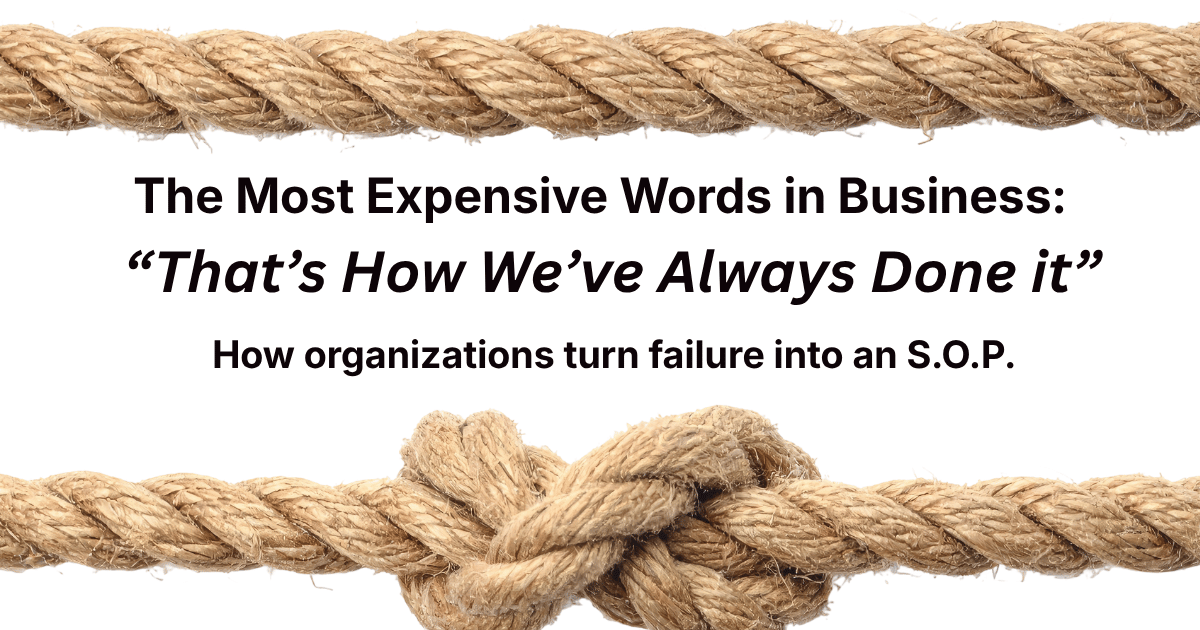
The Most Expensive Words in Business: “That’s How We’ve Always Done It”
“That’s how we’ve always done it” rarely sounds dangerous. It usually sounds practical. Experienced. Even responsible.
But every standard operating procedure began as a choice. Some choices are tested, measured, questioned, and improved. Others survive simply because they are familiar. Decades of research on status quo bias shows that people systematically prefer the existing arrangement over a better alternative, for no reason other than that it is the one already in place.
Eventually, no one remembers why the original choice was made. Repetition becomes its own justification. The process is no longer followed because the evidence supports it. It is followed because it has become the process.
That is how failure becomes an SOP.
Ask a room full of people, “Who wants to keep failing?” and no one will raise their hand. Organizations rarely choose failure that plainly. They choose the familiar process. The inherited assumption. The metric no one has revisited. The decision that once made sense but has never been tested against what happened afterward.
When a failure is catastrophic, people notice. Quiet failure is more dangerous. It can persist for years without producing a single moment dramatic enough to force examination. It quietly becomes part of the baseline, the budget, the forecast, and eventually the culture. This is what sociologist Diane Vaughan, in her study of the Challenger disaster, called the normalization of deviance: an organization repeats a flawed practice, nothing bad happens right away, and the flaw is quietly reclassified as acceptable. Because the organization has survived it, survival is mistaken for proof that the process works.
Then someone asks why, and the answer comes: that’s how we’ve always done it.
I cannot count how many times I have heard that phrase in places I have worked. The size of the organization does not seem to matter. There is comfort in repeating what we know, even when what we know is hurting us.
This is not merely a business behavior
It is a deeply human one, and researchers have studied it for decades. Its power is easiest to recognize in its most extreme forms.
While training to become a Court Appointed Special Advocate, or CASA, a volunteer appointed by a judge to advocate for the best interests of children who have experienced abuse or neglect, I learned how profoundly harm can reshape a person’s understanding of what is normal.
A child harmed by a primary caregiver often still loves, misses, and longs for that caregiver after being removed. This is not a failure of judgment on the child’s part. It is how human attachment works. John Bowlby, who built modern attachment theory, showed that a child’s drive to seek closeness to a caregiver is a survival instinct, and that instinct does not switch off when the caregiver is the source of harm. Harry Harlow’s research made the point starkly. Infant monkeys given surrogate mothers that blasted them with air or pushed them away did not learn to avoid them. They clung harder. Later neuroscience by Regina Sullivan found the same pattern in infant animals at the level of the brain: pairing a caregiver with pain in early life produced preference, not avoidance. Fear and pain can intensify attachment rather than break it.
The pull persists. Most young people who age out of foster care reconnect with the birth family they were removed from. One 2025 study of youth who had aged out found that roughly 83 percent were either still connected to or had sought out birth family, including relatives tied to the original removal. And when children are reunified with their families, about one in three are maltreated again. That is how strong the gravity of the familiar can be, even when the familiar was dangerous.
None of this means the child is choosing abuse. The child is reaching for attachment, predictability, and the world they know. Separation can create physical safety without undoing the bonds formed inside that environment. When harm has been normalized, the familiar can feel safer than an unfamiliar alternative, even when the alternative is objectively safer.
To be clear, I am not equating child abuse with a bad corporate process. They are not remotely equivalent. I start with the extreme because it shows, at the outer edge of human experience, how powerfully we are drawn to what we know, even when what we know has caused profound harm.
If the pull of “what we know” can remain that powerful under the most extreme circumstances, imagine how easily we can choose smaller, quieter harms. They do not alarm us. They arrive disguised as routine. We choose them again tomorrow because we survived them yesterday. Then we repeat that choice daily, sometimes for decades.
The consequences in our ordinary relationships and workplaces are far less severe. The scale is entirely different. But the human tendency is still recognizable. We return to what we know. Organizations are made of people, and people bring that instinct into the systems they build.
Familiarity begins to resemble safety. Repetition begins to resemble proof. Survival begins to resemble success. And failure, repeated long enough, begins to feel like the way things are supposed to be.
The systems we build, like the people we become, are the sum of what we allow and what those before us allowed.
The consequences of inaction
What I have learned from working with data inside some of the smallest and largest organizations is that results are not shaped by action alone. Often, the consequences of inaction outweigh the consequences of action.
Whether someone knowingly chose not to act, did not understand the need to act, lacked the authority to act, or never saw the problem at all is not always something we can know. We were not there. It is not our place to manufacture intent. But we can measure what happened next.
Every choice to act, or not to act, that causes more harm than good and is allowed to persist is like a knot tied in a rope. Each successive knot tightens the ones that came before it. Now imagine that continuing for years. Imagine it continuing for decades.
No single human being has enough time to trace and untie every knot. Not even an Eagle Scout or a Girl Scout with hundreds of badges could untangle that rope alone. It takes a diagnostic engine capable of finding where the tension began, tracing what each knot pulled out of alignment, and modeling what happens if it is released.
Because refusing to name the knot does not make it disappear. Refusing to see the failure does not erase the harm. It may protect the people closest to the original decision from accountability, but everyone outside the room where it occurred continues to absorb the consequences.
So I built a machine to help us untie the knots
I built Kochalla to give the people who can act and execute the ability to see failure, learn from it, and choose a better path. Not a system that claims to be strong because it has never failed. A system that becomes strong because it knows failure is inevitable and refuses to waste it.
I built an engine that makes accumulated consequences visible, so inaction can no longer hide behind uncertainty. That is an important distinction. Kochalla removes plausible deniability about impact. It does not pretend that measurable impact proves intent. Intent may be unknowable. Accumulated impact, however, is measurable.
Kochalla is built with the assumption that it may be wrong today, so it can be better tomorrow. That sounds simple. It is one of the hardest things for a human being, and therefore a human organization, to be.
Whether people in power resist being wrong because it benefits them, because they are protecting themselves, or because they are symptoms of the system that formed them is a larger conversation than I am qualified to settle here.
I am a data analyst. My work has always been to show what is happening beneath the symptoms. But eventually, witnessing the symptoms was not enough.
Most analytics systems are witnesses. They hold up a mirror after something has already happened and show a business the result. They can show what years of tying knots have created, after the rope has become one enormous ball.
I wanted to build more than a witness. I wanted to show what untying those knots could look like. I wanted to build the closest thing a business can have to a crystal ball.
Kochalla holds up the mirror so a business can see what its decisions have created. Then it models where the current path is likely to lead and what may become possible if the business changes course. It does not claim certainty. It models consequence.
Most importantly, I built Kochalla knowing that today’s answer may be wrong tomorrow. Kochalla is not built to protect an answer, a person, or a process. It is an engine built to expect failure and learn from it.
An action taken today is a hypothesis. It may be the best-supported choice available given everything we know at the time, but it is still a hypothesis. The outcome is evidence. The difference between what we predicted and what actually happened becomes learning. That learning can prevent future knots, or it can be buried, defended, and tied into the system as the next one.
Kochalla completes the loop. It predicts, observes, measures, compares, learns, and predicts again. It looks back at what it got wrong, updates what it understands, and returns clearer.
Kochalla cannot tell you why someone made a decision. But it can tell you what that decision has affected, where the current path is leading, and what the future could look like if the business chooses another one.
Because intent may be unknowable. Accumulated impact, however, is measurable. And what happens next can be modeled.
Every failure costs something. The real waste is paying that cost and refusing to learn what you purchased.
Don’t waste failure. You paid for it. Kochalla helps you see what you got for it.
- Samuelson, W., & Zeckhauser, R. (1988). Status Quo Bias in Decision Making. Journal of Risk and Uncertainty, 1(1), 7–59.
- Vaughan, D. (1996). The Challenger Launch Decision. University of Chicago Press. Overview: NASA Safety & Mission Assurance, The Normalization of Deviance.
- Bowlby, J. (1969). Attachment and Loss. Overview: Attachment Theory, ScienceDirect Topics.
- Harlow, H. F. Surrogate mother experiments, including rejecting and harmful surrogates. Summary: Harlow’s Monkey Experiments, Simply Psychology.
- Sullivan, R. M., et al. Neurobiology of Attachment to an Abusive Caregiver: Short-Term Benefits and Long-Term Costs. Developmental Psychobiology.
- Havlicek, J., Holland, S., & Taussig, H. (2025). Navigating Relationships With Birth Family After Aging Out of Foster Care: Experiences of Young People.
- Poirier, M.-A., & Hélie, S. (2014). Study of family reunification and repeat maltreatment. Children and Youth Services Review, 46, 257–268. Summary: ScienceDaily.